Does Acupuncture work?

The World Health Organization (WHO) has declared, in 2003, that it does – in valid clinically controlled trials.  They have posted some of those scientific studies on their website as well as an 87 page report detailing their own findings on Acupuncture.

Click on the link below to see for yourself.   (2018 update – WHO changed their website and I can not yet find where they moved the report; but I’ll put the WHO link below anyway).

Here is an opening to one of the WHO report pages:

“Over its 2500 years of development, a wealth of experience has accumulated in the practice of acupuncture, attesting to the wide range of diseases and conditions that can be effectively treated with this approach. Unlike many other traditional methods of treatment, which tend to be specific to their national or cultural context, acupuncture has been used throughout the world, particularly since the 1970s”.

WHO website link.

Straight from the website are 27 diseases/disorders that WHO found scientific evidence which supported/”proved” that Acupuncture was good for (see below).  And on their site this list is followed by another list of 63 conditions which scientific studies have shown benefits for, but broader studies are needed before WHO will call those diseases/disorders ‘proven’ to be effectively treated by acupuncture:

1. Diseases, symptoms or conditions for which acupuncture has been proved-through controlled trials-to be an effective treatment:

Adverse reactions to radiotherapy and/or chemotherapy
Allergic rhinitis (including hay fever)
Biliary colic
Depression (including depressive neurosis and depression following stroke)
Dysentery, acute bacillary
Dysmenorrhoea, primary
Epigastralgia, acute (in peptic ulcer, acute and chronic gastritis, and gastrospasm)
Facial pain (including craniomandibular disorders)
Headache
Hypertension, essential
Hypotension, primary
Induction of labour
Knee pain
Leukopenia
Low back pain
Malposition of fetus, correction of
Morning sickness
Nausea and vomiting
Neck pain
Pain in dentistry (including dental pain and temporomandibular dysfunction)
Periarthritis of shoulder
Postoperative pain
Renal colic
Rheumatoid arthritis
Sciatica
Sprain
Stroke
Tennis elbow
NCNM Study Abroad

NCNM offers trips and study opportunities abroad.  China, Rwanda, Tanzania, and Uganda are just a few countries that have recurring trips.  Here is a link to the African countries information:  NCNM website

Here is an example of a study abroad class, the class currently counts for credit in the NCNM ND, MSiMR, and MSOM degrees.

NCNM Tanzania Trip Description (Tentative – subject to change a little)

Week 1 (July 7-11) – Portland. Reading, videos, discussion.
Students will spend 9 a.m. to noon each day with Dr. Zwickey preparing for the trip. There will be readings, videos, and discussion about international public health, tropical diseases, and cultural topics relevant to Tanzania. Students will start their projects which will be presented the last week of the trip.
July 12 – Fly to Dar Es Salaam, Tanzania.
All students will fly to Tanzania on the 12th of July. Students may fly whatever airline they choose. However, because we will need to pick them up in Dar Es Salaam, it’s important that everyone arrive on the 13th.
July 13-15 Orientation; Basic Swahili; Jet-lag recovery
Students will arrive on the 13th or 14th (often flights land at 2 a.m. the next day). We’ll stay at Kigamboni, on the beach. Student will have the opportunity to sleep, swim, and will complete some local orientation.
July 16-17 Muhimbili University Institute for Traditional Medicine and CDC
Muhimbili University has an Institute for Traditional Medicine, where they study some of the 10,000+ plants that grow in Tanzania, analyzing them for activity against HIV, cancer, and malaria. We’ll tour their facility and talk to some of the scientists who work at Muhimbili. We’ll also spend some time talking to a public health expert from the CDC who works in Tanzania.
July 17 Fly to Moshi/Arusha
July 18-19 Orientation to Moshi, Mowo, Arusha
Located at the base of Kilimanjaro, this area is where we have relationships with researchers and some smaller villages. All students will visit Mowo, a village outside of Moshi.
July 20-22 Off (Ngorogoro Crater (optional safari) /Massai Village (optional village stay)
A popular safari takes place in Ngorogoro crater. Students will have the option to go to Karatu, and complete the Ngorogoro safari. Additionally, an herbalist who has lived with the Massai will provide herbal medicine history, and arrange a village stay with Massai villagers.
July 23-27 Activities in Moshi, Mowo, Arusha (optional village stay)
Students will alternate between 3 activities, a clinic day in Mowo village, visiting the herbal medicine research center on Mt. Meru, outside of Arusha, and completing public health activities.
July 28 Drive to Lushoto / Hike
July 29 Free day (or hike to waterfalls)
July 30 Drive to Tanga
Tanga is a coastal city that is primarily Muslim.
July 31-August 2 Tanga (Mama-Baby Clinic; Bombo Hospital; Bongo)
Students will alternate between three activities, including visiting a Tanzanian hospital, spending time with a traditional Tanzanian herbalist, and helping with a Mama-Baby clinic. Students will also deliver public health lectures at a local elementary school.
August 3 Boat to Zanzibar
August 4 Off
August 5-7 Stonetown; Spice Farm; Wrap up classes; Presentations
August 8 Leave
Course information will be distributed and discussed at breakfasts and dinners. Daily reflections will occur with faculty during drives to various locations.
After August 8th, students are welcome to fly back to the US, or to stay in Tanzania to travel and explore. Students may also want to spend time in other parts of the world on their way back to the US. Note that the last night of paid housing is August 7th.

First Term of Medical School

Fall 2012 at National College of Natural Medicine (NCNM) where I was enrolled as a first year ND (Naturopathic Doctorate) and MSOM (Masters of Science in Oriental Medicine) student.  Unfortunately, ‘Dual Degree’ students, as they are called, do not get any MSOM classes until their Spring Term during the first year.  So this summary is on the ND classes only.

Overall Summary:  The common euphemism for medical school is that “It’s like drinking from a fire hose”.  That is to say, that there is so much information coming at you, so fast, that it’s hard to catch and retain any of it.  While it does feel like a fire hose of information – you are expected to retain ALL of it – at least until the next exam.  (Luckily, at NCNM, most of the exams are not cumulative).  In some cases, you are given only the highlights of topics and have to go fill in the details (which are necessary to pass the exam) from a book you might buy, the internet, or hopefully, pulling from the pre-reqs you took.

What’s nice is that the classes start to overlap.  Anatomy and Organ Systems.  Biochemistry examples and Organ Systems.  Clinical Correlates case studies and Organ Systems, etc.  Even during the first term you start to see that the information isn’t endless – the body only has so many parts and so many key processes.  Learn those and you can start applying future classes to that base knowledge.

Words of Wisdom:  Take as many courses as you can before you start medical school – not just the ones required to attend the school, but the ‘Suggested’ courses too.  Take lots of physiology and anatomy.  I didn’t have any.  Every class has these subjects as their basis, even if it’s just in the use of examples.  Even though you might take these courses you will still  find the curriculum challenging.  Physics, Biology, Chemistry, Organic Chem., BioChemistry are all necessary as well. These concepts are assumed to be in the forefront of your mind (luckily for me that was the case).  The medical courses take off from there.  Get a ‘private’ tutor immediately – these are upper classmen on Work Study.  An hour of their insight can save you 3 hours of trying to decipher Power Point slides.  And it gives you unparalleled access to the type of questions that will be on exams.

My experience:  I am 41 years old.  I have a Bachelors Degree in Mechanical Engineering from the University of Michigan.  I have an MBA from my time at General Electric, from a program they have with Marquette University.  I am an overachiever.  I took every course at GE I could – including their intensive Statistics Training called “Six Sigma”.  I learn fast and I’m into details.  None-the-less, this curriculum required 110% of my time.  Finding time to eat or exercise was nearly impossible.  If you get sick or have to attend to personal business, nothing slows down, sure you can ‘make up’ exams – but when?  It’s like you fell off of a train going 80 miles an hour and now you have to run to catch up.  It may sound like I’m being overly dramatic, but I’m not, you’ll see.

I had another 40 year old tell me it was like a 9-5 job and she didn’t study evenings or weekends.  She must have taken all the classes before she got here.  I don’t see any way to pass the tests unless you are studying in between classes, at night, and at least one and a half days on the weekend.  It’s just too fast, you are in class too many hours, and the level of detail required on the exams is too in-depth.  I have always been a B+/A- student.  For the pre-reqs I was an A+ student.  At NCNM it’s Pass/Fail but you still know your percentage:  mine was 60-80%.  Passing is 70%.

I found the information extremely interesting.  And it would be great to slow down a bit and absorb it.  But there is so much being crammed into the 4 years to prepare for the State Board Licensing Exams that slowing down is not possible.  And this is how MD medical schools are too.  How are any of the schools turning out decent Doctors?  The 4 year curriculum is ridiculous.  And yes, it’s doable (but at what cost to your personal health?), so the pace continues.  At least at NCNM the Administration knows how hard it is and offer alternatives.  They offer 4 year ND because all the other ND schools do too.  And ND schools offer it because MD schools do it in 4 years.  At NCNM there is an established 5 year track and some students take even longer.  Don’t worry, the 5 year track will still be challenging – do yourself a favor and start in that.  I’ve heard many students call the 5 year ‘The Happy Track’.

THE MAIN CLASSES and their NCNM PROFESSORS

Organ Systems

This is the bulk of the first year classes.  Extreme detail of body organs and how they work is taught.  Very interesting – to a point.  And then your mind says – really? I need to know these minute details?  Yes, you do for the test.

Biochemistry

This is the little brother of Organ Systems.  Just as much detail is required, but the amount of material is less.  It’s really challenging for non-science majors.  Only the highlights are given and you have to go find resources to teach yourself the material.

Anatomy – 

If this is your first exposure to anatomy and physiology you have a LOT of memorizing to do.  The professors are so flexible at NCNM that they don’t require a text book.  This was NOT beneficial for me since I hadn’t had anatomy before.  Get one of the recommended texts ASAP and start memorizing.  I found ‘Clinically Oriented Anatomy‘ by Keith Moore, et. al. to be great – it has drawings, real cadaver photos and x-rays….all of which you will need to know.

The ND Professors – 

The professors of these main classes are excellent.  They know their subject area extremely well, try to keep up with the latest developments, and aren’t afraid to tell you when they don’t know something.  They are more dedicated to the students and more personable than most college professors at the three other colleges I’ve attended.

NOTE:  As of 2013 the ND Curriculum at NCNM is going through a review and will be changed.  Check out their website or call the Admissions Counselors for more information.

First Week at NCNM

The first week at NCNM felt like being

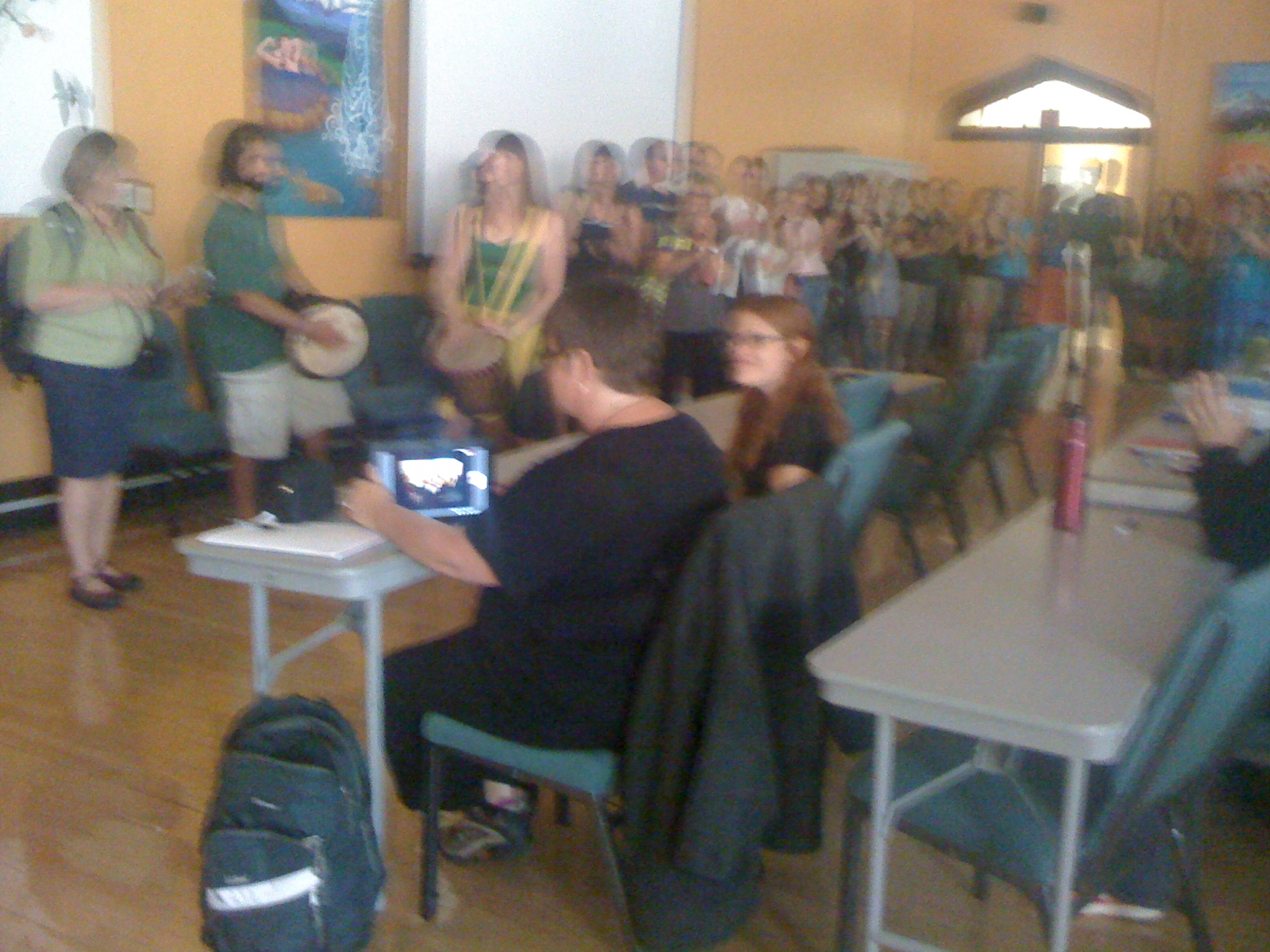
Low light attempt to capture the drumming circle with my iPhone.

in the dryer with a bunch of clothes….it’s a swirl of new people, your own positive and negative emotions, biochemistry equations, body parts and names, research tools and talk, new classroom environments, new computer systems, to take an elective or not?, a new commute, different schedule everyday, to buy books or not?, etc., etc.

It is at once daunting, exhilarating, fun, and scary.

It is also clear that you are not alone and the administrators, upperclassmen, fellow classmates, professors are here to help you – you just need to ask. And it is emphasized that one of the best tools a doctor can possess is the ability to ask for help.

The first class of our entire school career started with a Drumming circle. As all (approximately) 90 us waited for the Biochemistry professor 3 drummers started a beat in the hallway. They entered the room and were followed by 100 clapping upperclassmen, teachers, administrators, and counselors. It was an awesome upbeat tempo that quickly got all the new students clapping as well. Once the drumlin line and people had completely surround the tables we were sitting at there was a brief Welcome introduction. Then the drummers and clappers filed out of the room clapping and drumming the entire way. It was so uplifting, welcoming, and ‘yang’!

Other professors started their classes with: meeting for a moment of silence in ‘the heart space’, singing and dancing, a small speech about this journey we were embarking on, and, yes, some even just introduced themselves and the topic of the class straight away.

Other notable first week items and quotes:
– Two back to school parties sponsored by the school
– “It’s best if you wear a sports bra and biking shorts to this class”. (Palpatation Lab)

Sinus Infection

My husband gets recurring sinus infections every 12months or so.  While we are working on a long term solution to this we had to find a better short term solution other than antibiotics.  I had him try a general Chinese Herb combination and found it works quicker and better than antibiotics!  There are several Chinese Herb combinations to use depending on your individual symptoms so it is best to go to your Acupuncturist/Chinese medicine practitioner to get what’s best for you.

The company for the Chinese Herbs I use is Kan Herb Company.
I’ve bought the herbs many times from MomEMineral.com (also on e/bay).
And now I found Healthsuperstore.com to have many of them for even cheaper.  Otherwise you have to go to a healthcare provider to get them.

Bi Yan Pian is the one to get for Sinus infections.
Get at least the 2 oz. size  (watch out the company is phasing out the 4oz size)
Store in your cupboard.
Shake before every use.  Bottle will tell you how many drops to use.
Put in water and drink.  You can also put it in tea or juice.
Use three times a day (I’ve found that 2 times isn’t enough for me or the kids).

Many formulas come in pill form too but it takes longer to have the desired effect.

My husband, Todd, has the same reactions as when he takes antibiotics….that is within 24hours – when it ‘hits’ him, he has to go laydown/sleep, then his sinus swells more while his body is fighting the bugs, then  36 -48 hours after he started the herbs he starts to feel better (often he feels normal by then).

Use it until the symptoms are gone and then for another 3-5 days to make sure all the critters are dead and gone.

Let me know your experience with it if you try it 🙂

Pre-attendance at NCNM

In two weeks class starts at the National College of Natural Medicine.  The incoming class was put onto a Google Group to receive information from the college and about each other.  For several months people have been posting introductions of themselves; their educational and personal background, area of intended study, etc.  There are about 110 people on the group.  I finally was inspired to post my introduction, but took it a completely different direction:  Educational Poetry!  (LOL and making fun of myself).  And I’ve posted it here for your review.  Hopefully it will inspire some of the blog readers to come and join us!

“Dear Future Friends,

As a form of introduction I humbly offer up and wholly dedicate these words to you:

The Beginning
There were hundreds of paths leading to this precipice on which we now stand.
From here our choices substantially narrow,
Mostly because the climb ahead is so steep.
Some of us know precisely how we got here, counting every week, month, or year.
Others woke only yesterday, surprised to find themselves in this place.
No matter,
For now we are united, both in purpose – to obtain a degree,
And in intent – to learn to heal others.
Still there are paths to choose,
Some will go it alone relying on their own ropes and knots.
Others will need a lot of support and help and will find those willing to give it.
All of us together, forming a community,
Sharing Love and Laughter,
Joy and Sorrow . . .

Becoming a family over the next several years.

Let us learn as much from each other as we will from our studies.
And heal one another so that we may meet our clients with no ego –
Only clarity of purpose and unending compassion.
Let us be not afraid during this time of transition,
For we will meet the challenges as one –
A rising tide of strength, a tribe called ‘healers’.
Overflowing with momentum and grounded in wisdom,
Our powerful journey begins with a first step;
So breathe deep,
Join the outstretched hand of another,
And let us begin . . .
                                      -NCNM Fall 2012.
______________________

Amy Buckley
ND/MSOM
NCNM Incoming Class Fall 2012″

Sleeping Aids

Losing sleep is one of the worst symptoms to have and, in my opinion, should not be tolerated.  This is one area where you should get help right away.  Obviously work to figure out why you can not sleep and fix it.  In the mean time, you need your brain to work for you and the brain can’t work without sleep.  Here are some natural sleep aids that have worked for me or my family and friends:
  • Somnapure available at CVS Pharmacy
  • Tyler Sedaplex  from Integrative Therapeutics (probably need to get through a healthcare provider)
  • L-theanine (from Vitamin Shoppe or anywhere, it’s a natural amino acid)
  • L-arginine (from Vitamin Shoppe or anywhere, it’s a natural amino acid), you may need to take several grams of this for it to work to put you to sleep.
  • Tea – made from the ingredients listed below.  You can drink it to fall asleep and then keep some on your nightstand to help you fall back to sleep during the night.
Look for any pills with ingredients like:  Hops, Valerian, Skullcap, L-theanine, Jujube, Passionflower….all these things are natural sleep aids.  Some of these and more are described below:
Here is a description of what the Somnapure ingredients do (from the company):
Lemon Balm: An herb in the mint family used to promote sleep through relaxation;
Hops: A flower cluster used to increase alpha-waves, decreasing the time it takes to fall asleep;
Chamomile Flower: A daisy-like flower known for its calming effects and use in herbal teas;
Passion Flower: A beautiful flower used to promote sleep;
Melatonin: A naturally occurring compound that helps regulate sleep patterns;
Valerian: A perennial herb used for centuries to promote relaxation and reduce the time it takes to fall asleep;
L-Theanine: An amino acid commonly found in green tea that exhibits a relaxing effect.

Beans in a Rice Cooker?!

    This is absolutely the best kept secret about beans!  Cooking beans in a rice cooker is faster, easier and more delicious than cooking them in a pan (or getting them from a can).  

    Since beans are one of the 5 foods I can eat right now and cost $1.70 a can I was trying to find a way to lower that cost.   Not to mention the salt, preservatives, and all that metal that needs to be recycled when you consume 3 cans a day!  Dry beans cost about $1.70 per pound dry – or about 3 cans worth!  I tried cooking via the stove and the beans kept turning out dry inside.  This method makes pinto and reds firm on the outside and creamy on the inside.  White and navy get a bit destroyed – and almost tastes like soup! 

    How to Cook them:  

                1. Follow pre-soak directions on the package.

                2. Caution! – some beans give off poisonous gases/substances that can make you sick, if they are not properly pre-soaked (ie. boiled for at least 10minutes).  Red and kidney beans are two examples.  Slow cooking these beans has lead to food poisoning.

                3. Rinse and place in rice cooker, cover with water (less than 1" past the bean level), press cook.

                4. When done, cover again with water and press cook a second time.

                5. Rinse, drain, and eat your perfectly cooked beans.

                6. Tip – I make so many at once that I put some in the freezer.

For Best Results:  

– Use small beans (white, navy, pinto, red, etc.).  

– Adding too much water will cause a lot of excess to spill out of the rice cooker during cooking – that can be a mess.  

– Put a few wash clothes around to catch the excess water your first few trys.  

– I have cooked up to 6 cups of beans in my 8 cup rice cooker.

– I pre-soak overnight in the rice cooker too.

Enjoy!

CHAKRAS

I have found the ideas behind the Chakra system to be helpful in understanding what's going on with my body physically, mentally, and spiritually.  This one page of notes I took long ago has served me very well on my healing journey.  There are seven Chakras or 'energy centers' that correspond to different aspects of the body as noted below.  

My notes from the book, Chakra Healing, by Rosalyn L. Bruyere  1990

1.  RED – Physical Body Sense

Chakra Location:  at the perineium.

Prime body part: Pelvis.

All nerve endings connect to here.  Survival needs, pleasure, and pain are all located here.

Psychological growth stage:  4 years old – self separate from others.


2. ORANGE – Emotional Body

Chakra Location:  below the belly button.

Prime body part: Intestines.

Where all feelings are processed.

Psychological growth stage:  7 years old – want others to feel as they feel.


3. YELLOW – Mental Body

Chakra Location:  above the belly button and below the V in the rib cage.

Prime body part:  Spleen, stomach, kidneys, adrenals.

Where all thoughts, opinions, and judgements originate and are controlled.

Psychological growth stage:  12 years old – digesting data.


4. GREEN – Astral Body

Chakra Location:  to the right of the actual heart.

Prime body part:  Thymus, Auto-immunity.

Bridges real world and the spirit/dream world.

Psychological growth stage:18 years old – consider other before selves, make no decision without considering higher ideals and dreams.


5. BLUE – Eupheric Body

Chakra Location:  over the throat.

Prime body part:    Thyroid (controls growth and metabolism).

Controls time and speech.

Beginning of god-like abilities.  "Knowing the right time for things".

Psychological growth stage:28-35 years old – idealistic especially in regards to justice and truth, concept of perfection.


6. INDIGO/VIOLET – Celestial Body

Chakra Location:  on forehead, between the eyes and slightly above them.

Prime body part: Pinneal Gland (a light sensitive neurotransmitter).

Holds your individual future and is our access to understanding the future.

Realm of light that allows us to "see the Light" from a clairvoyance perspective.  Home of insight, inspiration, intuition, psychic phenomena, visualization. "The Third Eye".

Psychological growth stage:  45-50 years old – wiser self.


7. WHITE (Rainbow, all colors) – Catheric Body

Chakra Location: on the crown of the head; ie. on top of head even with the ears.

Prime body part:  N/A.

The record of your whole spiritual life is here.  Oneness with God is here.

Psychological growth stage::  Ageless – higherself, most like god we can be at this time.


NCNM Admissions Interview

I recently spoke with an NCNM hopeful, Victoria, about her admissions interview.  Here is what I learned:

Which program?   ND and MAc (Masters of Acupuncture),  Dual Degree Program.

Who interviewed her?    1 ND faculty member who is an ND/MD; 1 Admissions Counselor; and 1 Chinese Medicine faculty member.

Interview situation:  All 3 NCNM representatives and her in a conference room at NCNM.

Length of interview:  1 hour.

Questions she was asked:        

  • What will you do if you don't get into NCNM?
  • What would you do if . . . quite a few of these types of questions.   One example is: What would you do as a practicing ND if one of your patients is blaming you for a side effect of a medication or supplement?
  • Personal background questions.
  • General Resume type of questions.

After the interview:  Within 2 weeks she received a phone call from the Admissions Counselor confirming her 'conditional acceptance' to the ND program.  This was followed with a formal letter, instructions, and paperwork.  Her acceptance was "conditonal" because she still needed to finish and pass two more of the required pre-requisite courses for entry to the program.  She was given a deadline to confirm her acceptance and send in a monetary deposit.

Her advice on interviews:  Know yourself and where you stand on healthcare issues, naturopathic medicine, and morality-type scenerios.  Don't be worried – it was a friendly atmosphere.  Take your time to think of your answer before starting to speak, silence is ok.  Try to be calm so that the real you comes through.

Her Background:  She is 45 years old.  She is an introvert.  She currently lives and has lived most of her life in Portland, OR. Since she was 2 years old she wanted to be a Medical Doctor (MD).  Her father was in the Biochemistry field and her mother was very into Natural Health methods when she was young.  In college she married and had children and so she ended up as a Registered Nurse (instead of an MD).  She is now divorced and her children are living on their own, so three years ago she set out to get her Bachelors degree in Nursing (a first step towards a doctorate).

Why Natural Medicine?:   After 15 years working in healthcare (a lot of it with mentally ill patients) she became disillusioned with the current healthcare system.  She witnessed time and again how medications were prescribed to people and it did not help them, often made them worse, and did not get at the root cause of their illness.  She was determined to be a different kind of MD.

    Then, one year before finishing her bachelors degree, she heard an ND speak at a Martial Arts Camp she was attending.  She spoke to him afterwards and learned about NCNM.  She knew immediately that becoming an ND instead of an MD was the route she wanted to take.

Experience with Natural Medicine?:  Introduction to it as a child from her mother.  Currently she sees an ND/LAc (Licensed Acupuncturist) and another ND.